Description
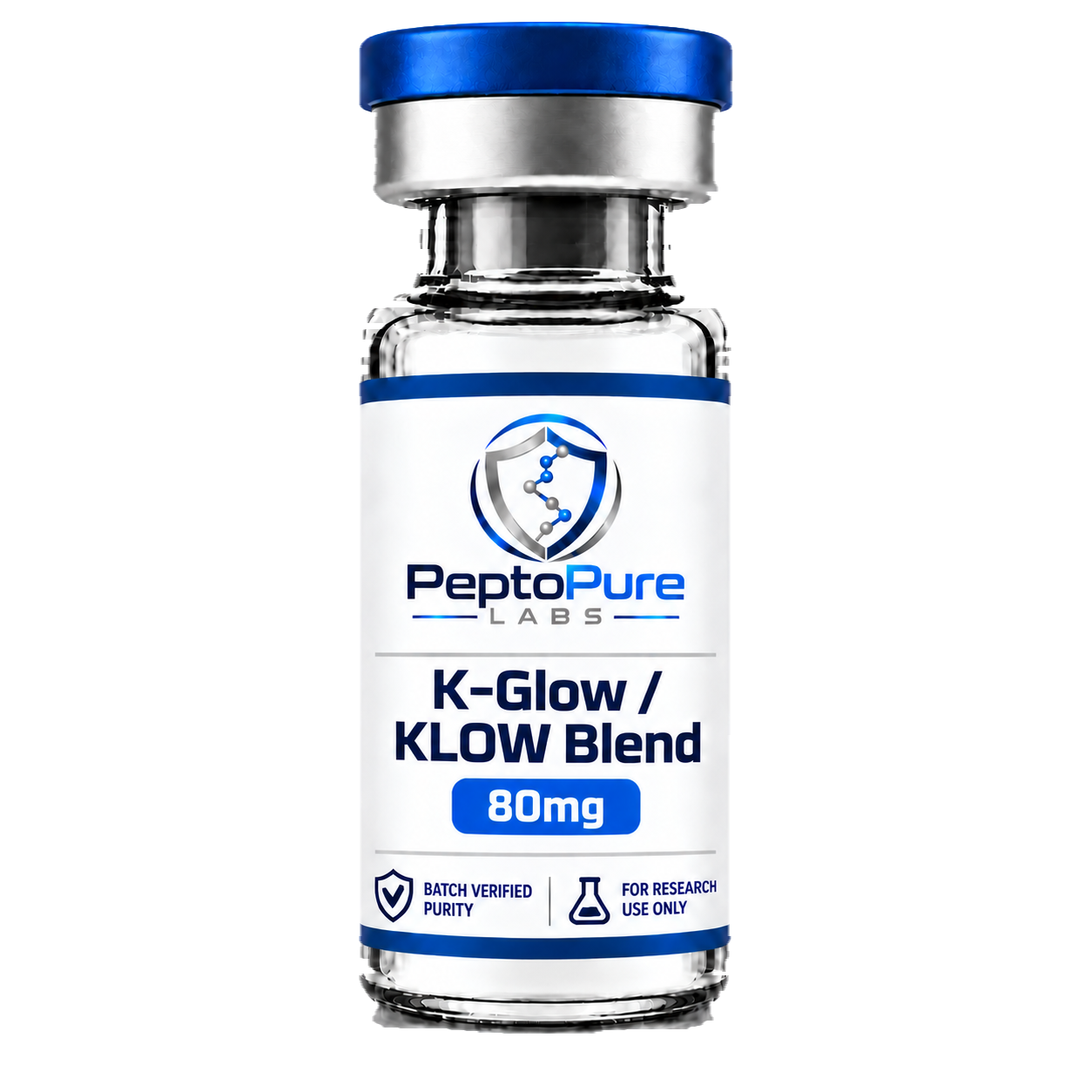
KLOW Blend (K-Glow) 80 mg
Buy KLOW Blend (K-Glow) 80 mg for laboratory research. Each vial contains a premixed blend of BPC-157, TB-500, GHK-Cu and KPV as lyophilized powder, for 80 mg total labelled material.
- BPC-157: 10 mg per vial
- TB-500: 10 mg per vial
- GHK-Cu: 50 mg per vial
- KPV: 10 mg per vial
- Total blend: 80 mg per vial
BPC-157 is a 15-amino-acid peptide (CAS 137525-51-0). TB-500 is full-length, N-acetylated thymosin beta-4: a 43-amino-acid peptide identified by CAS 77591-33-4. GHK-Cu is a copper-tripeptide complex (CAS 89030-95-5), and KPV is the tripeptide Lys-Pro-Val from the C-terminus of alpha-MSH (CAS 67727-97-3).
Choose the size and composition
KLOW Blend is offered as a single 80 mg vial. A premixed vial fixes the proportions of all four components. Separate BPC-157, TB-500, GHK-Cu and KPV products allow each compound to be selected independently. Milligram amounts do not translate into equal numbers of molecules, because the components differ greatly in molecular weight.
The GLOW Blend contains the same 10 mg BPC-157, 10 mg TB-500 and 50 mg GHK-Cu without the 10 mg of KPV.
What the component research establishes
Dalmasso and colleagues showed that KPV is taken up into intestinal epithelial and immune cells through the PepT1 transporter, where it reduced NF-κB and MAP kinase signalling and pro-inflammatory cytokine secretion; oral KPV reduced colitis in DSS and TNBS mouse models. Chang and colleagues studied BPC-157 in rat tendon explants and fibroblasts, Malinda and colleagues studied thymosin beta-4 in a rat skin wound model, and Maquart and colleagues studied GHK-Cu and collagen synthesis in fibroblast cultures.
Each study examined one compound on its own. None tested this combination, and the findings do not describe the properties or performance of this blend.
Review the COA and product files
The COA & Documentation page contains the available batch reports and product documentation. Check the lot and size, the identity assigned to each of the four components, and whether the report measures each component’s content separately. A combined purity percentage does not by itself confirm the labelled amount of each component.
The composition above describes labelled material, not a measured result for every lot. For handling and storage, consult records applicable to the complete mixture.